On August 25, 1862OR, vol. 13, 260., a Union cavalry patrol out of Salem rode up to the house of Joshua Chilton near the Jacks Fork. Three men ran from the house. The soldiers called on them to halt and then fired. Jesse Conaway fell mortally wounded, and Perry Chilton was shot at as he went into the brush. Chilton himself ran for nearly a mile, and the soldiers caught him in the river, “swimming through Jack’s Fork.”
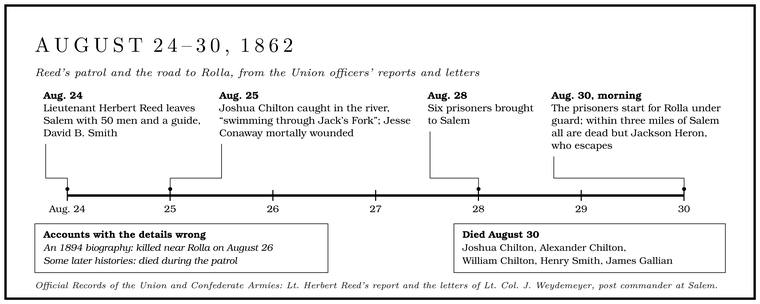
Chilton was the most powerful man in Shannon County. He had served in the legislatureRader 2017, ch. 4 (elected in 1861); Goodspeed 1894 (“Hon. Joshua Chilton”) has him elected in 1860 and “never permitted to serve”; OR, ser. 2, vol. 4, 465 (“the late State Senator”). and had been elected to the state senate on the eve of the war, and people called him the “King of Shannon County.” The patrol brought him and five other prisoners to Salem on August 28OR, vol. 13, 261; OR, ser. 2, vol. 4, 465., and the commander of the post wrote to his superiors that Chilton had done “more to induce men to join the Southern Army than perhaps any other man in this whole State.” On the morning of August 30OR, ser. 2, vol. 4, 471–72. the six prisoners started north under guard for the Union base at Rolla. Within three miles of Salem all of them were dead except one, who got away into the woods. The guard reported that they had tried to escape. The post commander rode out and found the bodies himself. The first man had already been buried where he fell, about thirty yards from the road. The others lay a mile and a half farther on, and Chilton’s body lay two hundred yards from the road, “in an opening of the woods.”
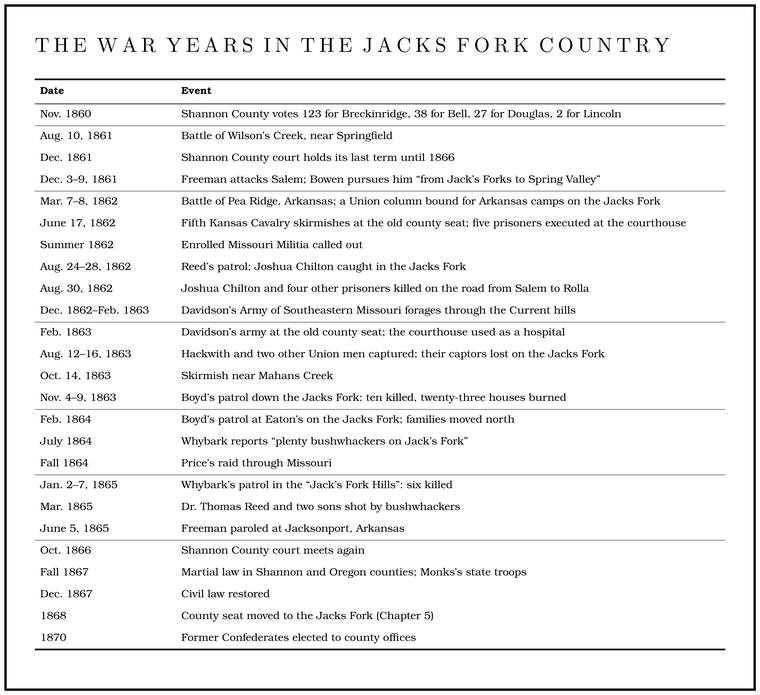
No battle was fought on the Jacks Fork. The war there was fought by irregular bands against small Union patrols, and it left no battlefield anywhere along the riverwaysBrown 1969, 67 (the war “was one of irregular forces against small Federal patrols,” and “there are no Civil War sites along the riverways”).. What the river had instead was four years of patrols, raids, burnings and killings, most of them carried out by men who knew their victimsStevens 1991, 58–61; Rader 2017, ch. 4; and the cases below., and a peace that took several more years to arrive (Table 6.2).
A county that voted South
Missouri was a slave state that stayed in the Union, and it was divided all the way down. In the spring of 1861 its governor, Claiborne Jackson, refused Lincoln’s call for troops and worked with the State Guard to take the state out of the Union. Union troops drove him from the capital in June, and the state ended the year with two governments. A Union government held Jefferson City. Jackson’s government, in exile, met with what was left of the legislature at Neosho in the fall of 1861 and voted to secede, and the Confederacy soon admitted MissouriStevens 1991, 53–54 (Stevens dates the Neosho vote November 1861 and the admission a month later; the ordinance of secession is usually dated October 28, 1861, and the Confederate admission November 28, 1861, so “the fall of 1861” covers both readings).. About 30,000 Missourians joined the Confederate army and more than 100,000Stevens 1991, 61. enlisted on the Union side. The Union victory at Pea Ridge, just over the Arkansas line in March 1862, secured much of Missouri for the NorthStevens 1991, 54., and the fighting that went on inside Missouri was mostly small, local and vicious.
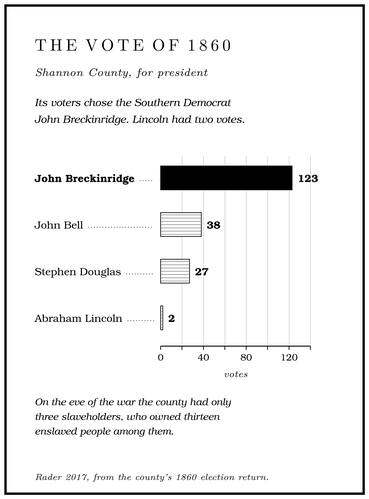
Shannon County leaned hard to the South. It grew almost no cotton, and on the eve of the war it had only three slaveholdersRader 2017, ch. 4 and n. 29, citing the county’s 1860 election return (Missouri State Archives)., who owned thirteen enslaved people among them. Its voters chose the Southern Democrat John Breckinridge for president that November: 123 votes for Breckinridge, 38 for John Bell, 27 for Stephen Douglas and 2 for Abraham Lincoln. Most of its families had come from Tennessee and Kentuckysee Chapter 5. (Chapter 5), and the county’s loyalty followed its leading families. The Chiltons were the first of them. By 1860 fifteen Chilton households with ninety-four membersRader 2017, ch. 4 (Rader, who grew up on Mahans Creek, traces the county’s loyalty to its leading families; “About the Author”). lived on the Current and the Jacks Fork, and many more families were related to them by marriage. Family tradition says Joshua Chilton tried to stay neutral at first, and he did not attend the rump session at NeoshoRader 2017, ch. 4; Stevens 1991, 54., but the Union officers at Salem considered him the leading Southern recruiter of the district.
On the lower Jacks Fork the Mahans held a similar place. William “Billy” Mahan was the wealthiest farmer in Delaware Township, the Township. A survey square of six miles on a side, holding thirty-six sections; also a division of a county, such as Jack’s Fork Township (Chapter 5). Glossary → that takes in most of the Mahans Creek valley, and had been elected a judge of the county court when the war began. Four of the nine men from Delaware Township known to have served in the war were Mahans, and all nine served the South. No man from the township is known to have served the Union.
Unionists were few, and they had reason to keep their heads down. Some of them left early. Others called in the Union garrisonsRader 2017, ch. 4. at Salem, Houston and Rolla against their neighbors, and the patrols that came often rode with a local guideOR, vol. 13, 260.. On the upper river, near the Forks, the. The North and South Prongs and their junction, where the Jacks Fork begins; also called the Prongs (Chapter 18). Glossary →, two settlers, Charles Beckelshymer and William Baskett, are said to have taken the Union sideLewis 1980, PDF p. 11, the only source; see Reach C. (Reach C).
Three kinds of fighters moved through these hills. There were Confederate officers raising men under commissions from the South. There were Union militia, and there were bands that served nobody but themselves. People in the hills called the irregulars of every kind Bushwhacker. In the hills during the Civil War, an irregular fighter of any side who struck from the brush and then scattered (Chapter 6). Glossary →, men who struck from the brush and then scattered.
The Union militia came in two kinds, and the reports from the Jacks Fork name both. The Missouri State MilitiaStevens 1991, 53, 61; Nichols 2007, “Winter 1863 in Southeast Missouri” and “Spring 1863 in Southeast Missouri.”, raised in 1861, was a standing force, most of it cavalry, serving full time, paid and armed by the federal government and enlisted to serve only inside Missouri. The Enrolled Missouri Militia came out of an order of July 1862 that every able-bodied man of military age in the state enroll. Loyal men were formed into companies and called out for home service when they were needed, for days or weeks at a time, and men who would not take up arms for the Union were put on the rolls as disloyal. In 1863 the state drew some of the enrolled men into provisional regimentsgeneral history of the Missouri militia (the State Militia of 1861; General Orders No. 19, July 22, 1862; the Provisional Enrolled Missouri Militia of 1863). that served full time, and it was from one of these, the Sixth ProvisionalOR, vol. 22, pt. 1, 746., that the Jacks Fork’s most remembered patrol came. Enrolling a county like Shannon was dangerous work, and its enrolling officer rode with a cavalry escortOR, vol. 22, pt. 1, 705–6..
Two Confederate colonels from Phelps County, Thomas Roe Freeman and William O. ColemanNichols 2007, “Spring 1863 in Southeast Missouri.”, were the Southern commanders whose names run through the Union reports from the Jacks Fork. Freeman had been a county judgeEncyclopedia of Arkansas, “Thomas Roe Freeman” (a member of the Phelps County court). before the war. Coleman was dismissed from Confederate service in July 1862 after he refused to merge his companies into another regiment, and several of his men went on fighting as independent bandsNichols 2014, “Fall 1864 in Southeast Missouri.” in their home neighborhoods. Many local Guerrilla. An irregular fighter of the Civil War. In the Mahans Creek country many were farmers who fought between crops (Chapter 6). Glossary → were farmers who fought between crops. In the Mahans Creek country they went out after the corn was planted and in other slack seasons, fired a volley or two at a Union patrol or supply train, and scattered into the hills to meet again at an agreed placeRader 2017, ch. 4..
The road through the county
The war came to the Jacks Fork along a road. Salem and Houston were outposts of Rolla, where the railroad from St. Louis ended in 1861general (the Southwest Branch of the Pacific Railroad reached Rolla in 1861). and the Union kept its supply base for southern Missouri. From those two posts, wagon roads ran south through Spring Valley and across the Jacks Fork to Thomasville on the Eleven Point and on into ArkansasOR, vol. 34, pt. 2, 176 (route of Lt. Col. John W. Stephens, January 1864); OR, vol. 22, pt. 1, 746., where the Confederate armies were. Union columns used that road on their way south, and Southern recruits used it on their way to join the armies. After each scout an officer wrote a report for his post commander, who passed it up the chain of command, and after the war the government printed the reports in the 128 volumes of the Official Records of the war, issued from 1880 to 1901U.S. War Department, The War of the Rebellion: A Compilation of the Official Records of the Union and Confederate Armies (Washington, 1880–1901); the dates as in Stevens 1991, 55 n. 6.. Those reports are most of what is known about the war on the river (Map 6.1). Written to explain where the officers had ridden and whom they had killed, they read like account books.
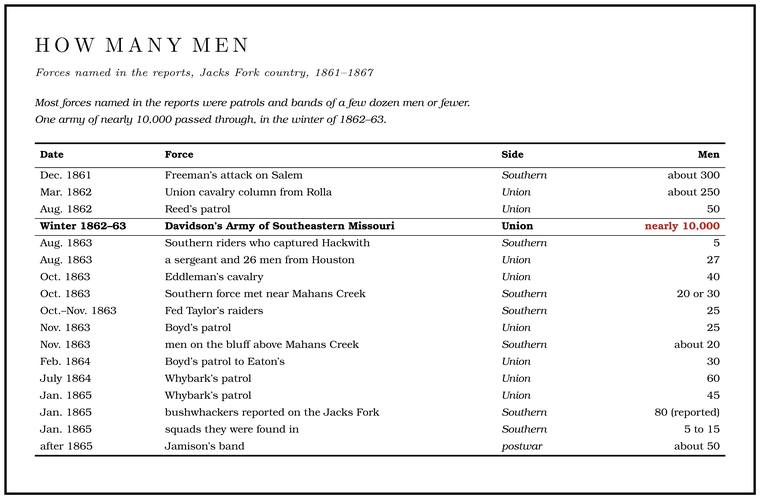
December 1861. On December 3 Freeman, with about 300 menBrown 1969, 21., attacked the Union post at Salem. The fighting ran through the streets of the town, and by one count six Union soldiers and thirteen of the attackers were killedMoore 1862, vol. 3 (the Salem fight of December 3, 1861), as given by Dickinson College’s House Divided project, which cites the volume without a page; the volume itself was not seen, and this is the only count found.. On the 5th Major William D. Bowen’s cavalry went after him. “I followed them from Jack’s Forks to Spring ValleyOR, vol. 8, 36–37; Brown 1969, 22., scouring the country in every direction,” Bowen reported, two nights and two days in the saddle, stopping only half an hour at a time to feed the horses, through “one of the roughest countries I have ever been in.” At times he was within four miles of Freeman. On the 7th his advance guard under a Captain Montgomery ran onto a party that fled into the hills, and the shots fired after it hit nobody. The timber was heavy and the nights dark, Freeman knew the by-paths, and Bowen never caught him. He turned back to Salem with his command out of provisions and forage, reporting the country “entirely destitute of everything in the provision line.” He brought in twenty prisoners and some thirty-five horses. He was satisfied the prisoners were all Freeman’s men, some of them taken with arms, and he asked his commander at Rolla what to do with them, suggesting that “if half of them were kicked and let go it would be the best thing we could do with them, for they are already near scared to death.” Freeman had fallen back to General James McBride’s State Guard command at Thomasville, and by Bowen’s report he was already coming north again toward the CurrentOR, vol. 8, 36–37 (Bowen to Acting Brigadier General John B. Wyman, Salem, December 9, 1861; the operation is headed “Expedition through the Current Hills”).. The commander at Rolla wanted four companies of cavalry and a battery of artilleryOR, vol. 8, 36 (Wyman, Rolla, December 10, 1861). kept at Salem for good. Freeman was captured in February 1862 and exchanged that SeptemberEncyclopedia of Arkansas, “Thomas Roe Freeman.”, and his name kept turning up in the hills until the end of the war.
February 1862. On February 17, 120 men of Major W. C. Drake’s command rode with Lieutenant Colonel Wood’s battalion on a scout through Texas, Dent, Shannon and Howell counties. They entered Houston without opposition and took a store of provisions, arms and ammunition there, and at West Plains they captured some of Coleman’s men after a sharp fightGoodspeed 1889, Texas County, “Military Affairs,” giving Drake’s report of March 4, 1862 (Goodspeed spells the battalion commander “Woods”)..
March 1862. A Union cavalry column of about 250 men left Rolla on March 7 bound for Arkansas. By one account it camped the second night on the Jacks Fork in Shannon County and marched on to ThomasvilleMonks 1907, 147–48 (William Monks, a Howell County Unionist who served in the region), the only source. the next day.
June 1862. Most of the Fifth Kansas Cavalry passed through the old county seat of Eminence, on the Current, on its way south to Arkansas, and on June 17 its troopers skirmished there with some of Coleman’s menNichols 2004, “Summer 1862 in Southeast Missouri”; OR, vol. 13, 2.. A Kansas cavalryman wrote in his diary that day that five bushwhackers were captured and executed in front of the courthouse, and that the youngest boysFellman 1989, 165, citing the diary of Augustus Bondi, entry for June 17, 1862, at Eminence (Kansas State Historical Society). of his company volunteered for the execution and the burial.
August 1862. Lieutenant Herbert Reed of the Third Missouri Cavalry left Salem on August 24 with fifty men and a local guide, David B. Smith. They halted at noon for dinner twenty miles out, on the Barren Fork of Sinking Creek, followed Sinking Creek down to the Current and the Current downstream, searched the house of Jackson SuggsOR, vol. 13, 260 (printed “Sugs”); the report as printed in Lewis 1980, PDF p. 71 (“Suggs”). and found nothing, and rode on through the night to a place called Chilton’s Mill. At the house of Andrew Chilton someone inside fired on them. The soldiers fired back, killing a man and slightly wounding a woman who stood near him. At the house of Cedrick Chilton they took Alexander Chilton, William Chilton, Henry Smith and James Gallian, along with a gun, a government saddle and four horsesOR, vol. 13, 260.. Then they came to Joshua Chilton’s.
Reed reported the country as he found it. It was dry until Sinking Creek, and beyond that “rough and hillyReed’s report as quoted in OR, ser. 2, vol. 4, 465. and supplied with an abundance of the purest of water, plenty of corn in the field, in the valleys some considerable fruit, peaches and apples, not very many sheep, an abundance of cattle, not much small grain,” with “two grist-mills and any quantity of hogs, though they are all poor.” Whenever his men saw a man run and leave a horse, Reed took the horse and left word that the owner could have it back if he proved himself loyal. On the 26th he left a guard on the prisoners and took the rest of his men twenty miles northeast to Big Creek, searching houses as he went. At Andrew Marsh’s, where the man of the house was said to be riding with Coleman, he found one stray horse in the woods. He took a bay mare at Benjamin Conway’s, and at Jackson Herring’s he found a bay mare and a horse hidden in the woods and took Herring along with them. A man named Goforth, whose son was with Coleman, ran and got away, and Reed confiscated his horses and coltsOR, vol. 13, 260–61; Lewis 1980, PDF p. 70 (“Took man and horses along”).. On the way home he took a wagon and oxen from Alfred Deatherage to carry the familiesOR, vol. 13, 261 (“whenever we saw a man run and leave a horse”) (spelled “Alfred Deathridge”). of the guide and of Dan Smith to Salem. The post commander at Salem reported that a force of 300 cavalry could take a thousand head of good cattleOR, ser. 2, vol. 4, 465. out of the Current valley alone.
The killing of the prisoners on the road to Rolla two days later went into the record as an attempted escape, a common epitaph for prisoners of the state militiaStevens 1991, 61 (“shot while trying to escape”).. Some later accounts put Chilton’s death near Rolla on August 26Goodspeed 1894 (“Hon. Joshua Chilton”)., while he was still in Reed’s hands, and others during the patrol itselfStevens 1991, 61., but he reached Salem alive. The post commander there, Lieutenant Colonel Joseph Weydemeyer, held him two days, and he died on August 30 with Alexander and William Chilton, Henry Smith and James Gallian. The sixth prisoner, Jackson Heron, probably the Jackson Herring taken at Big Creekan inference from the two names and from Reed’s taking Herring with him; the Salem letters spell him “Heron.”, escaped. Weydemeyer wrote that “nobody doubts that they fully deserved their fate.” His letters include charges against each of the deadOR, ser. 2, vol. 4, 465–66, 471–72; the escort commander’s report is at 472.: Alexander Chilton had robbed trains and killed stragglers, Henry Smith was accused of murdering a man named Worthington, and Gallian had bragged of killing a man on the road for his horse and eighty dollars. The killing enraged the Chiltons, the largest family in the county, and it probably pushed many of the county’s undecided families to the Southern sideRader 2017, ch. 4 (his judgment)..
Weydemeyer was a German, once a lieutenant of artillery in the Prussian army, who had become a follower of Karl Marx. He came to America in 1851, and the next year he published Marx’s The Eighteenth Brumaire of Louis Bonaparte in a German paper he started in New YorkFenwick 1948, 26–27 (reviewing Obermann’s 1947 life of Weydemeyer; his garrison was at Minden, in Westphalia; the paper was Die Revolution, 1852). The Missouri Historical Society identifies the J. Weydemeyer who commanded at Salem as Joseph Weydemeyer (Henry Almstedt Papers, A0022, which hold two of his letters).. In October 1862, with the district commander’s inquiry into the post quartermaster’s dealings under way, he asked to be relieved of the Salem commandMissouri Historical Society, Henry Almstedt Papers (A0022), folder 1, letter signed “J. Weydemeyer, Lt. Col. Comd. Post, Military Post, Salem, Mo.,” to Col. Henry Almstedt, October 3, 1862 (Col. Glover, commanding the Rolla District, had ordered testimony taken on the post quartermaster’s transactions; “I am seeking removal from this command”).. He died in St. Louis in 1866Fenwick 1948, 26–27. The usual biographical notes give the day as August 20, 1866, and the cause as cholera, after a St. Louis newspaper notice not seen here; neither is used..
The Chilton family told the story its own way and kept telling it. Nearly seventy years later a kinsman set down for a Van Buren newspaper the account that the relatives of the dead had handed on. In the family’s telling the raid grew out of two private quarrels. John Worthington had turned against Joshua Chilton over a wrong the family called imaginary, and Dave Smith against Alexander Chilton over one it allowed was real, and between them they got a company of Federal soldiers to come over from Rolla and ride on the Chilton houses in the night. A. J. Chilton heard them coming, went out a window in his nightclothes, and got away on all fours among the sheep in his yard. At Sam West’s, Sam crawled under a bed while his father, John, talked the soldiers away from the porch. Then Sam fired on them from the door and missed. Their answering fire killed his father, and it struck Sam’s wife as she pushed him back into the house, and she died about two weeks later. The soldiers came on Joshua Chilton’s family at breakfast. He and Louis Conway ran and hid in the weeds of an old house lot half a mile off, where Conway was found and killed, and Chilton was caught by a soldier who had wandered away from the othersJohn J. Chilton’s account in the Current Local (Van Buren), as printed in Lewis 1980, PDF pp. 70, 73 (the account opens “Sixty-nine years ago, last week,” so about 1931), the only source for the family’s telling..
On the first night of the march north, by this telling, the prisoners were kept in an empty house with two doors, and one of the guards fell asleep. James Galyon, lame from a leg broken some months before, wanted Alexander Chilton to knock the guard down with a boot so the rest could run. Joshua Chilton, a Freemason, told them to stay, trusting two Masons among the guards to save them all. The next morning Galyon could walk no farther and was shot where he sat. The guards over Henry Smith and William Chilton lagged behind out of sight and shot them, and the rest of the prisoners were made to take off their shoes. Joshua Chilton asked the two Masons whether they would see him “shot down like a brute,” and one answered, “You can’t tell any difference.” Alexander broke into the brush and got away. At a spring a mile on, a young woman washing clothes threw a pile of unwashed laundry over him and sent the soldiers off the other way, and he reached home eight days later, having eaten nothing but apples. By the same telling he afterward went with Charles T. Chilton and Jack Smith, a brother of the dead Henry Smith, to Worthington’s house and killed him there, and he followed Dave Smith to Illinois, where Smith ran a ferry boat, and at last to central Texas, where, he told Joshua Chilton’s widow, he had last seen Smith lying dead by a saloon doorsame, Lewis 1980, PDF pp. 70, 73. Chilton’s retort (“I have friends that can wade as deep in blood as you”) and the details of the wounds are left in the source. Lewis puts Worthington’s house “in the vicinity of Round Spring.”.
The family’s story and the officers’ papers agree on the night ride, on Chilton taken on the run and on the prisoners shot on the road, and differ over who died. The family counted eleven deadsame (John West, Mrs. Sam West, Louis Conway, James Henry Galyon, William Chilton, Henry Smith, Sam Herring, Jack Herring, John Huddleston, John Story and Joshua Chilton)., John West and Sam West’s wife among them. Reed’s report has one man killed and a woman slightly wounded at a house where his men were fired on, and the woman may have been Mrs. WestOR, vol. 13, 260 (at Andrew Chilton’s, “Names unknown”); the identification is a guess.. Where the family’s Alexander escaped, the Salem papers list an Alexander Chilton among the dead and make Jackson Heron the man who got away, and they charge Henry Smith with having already murdered a man named WorthingtonOR, ser. 2, vol. 4, 465–66, 471–72.. Reed’s guide was a David B. Smith, perhaps the family’s Dave Smith, and on the way home Reed took a wagon to carry the families of David and Dan SmithOR, vol. 13, 260–61; that the guide was the family’s Dave Smith is a guess. The family’s Jack Herring among the dead may be Reed’s Jackson Herring, the escaped Jackson Heron of the Salem letters. to Salem.
Winter 1862–1863. The largest Union force to cross these hills came through that winter. General John W. Davidson’s Army of Southeastern Missouri, nearly ten thousand men in thirteen infantry regiments, three batteries of artillery and a brigade of cavalry, set out from Pilot Knob, where the St. Louis and Iron Mountain Railroad endedStevens 1991, 54–55., and marched toward Arkansas hunting for Confederate forces it never brought to battle, except for a cavalry dash on BatesvilleStevens 1991, 56.. Its supplies had to come over the hill roads from the railhead, and the roads gave out under it. A supply train of three hundred wagonsStevens 1991, 57 (the soldier’s words from Bradbury’s notes). bogged down in the mud, the men went on half rations, and much of what did arrive had spoiled. The army lived off the country. A soldier wrote that “the poor devils are suffering terribly from the troops, who take the liberty of filling their haversacks from the stores of these natives.” Davidson said his men had cleared the country of corn and cattle all the way from Pilot Knob to West Plains, and one trooper reckoned they stole thousands of hogs. “This problem of food over such roads has put some gray hairs in my head,” Davidson wrote at the end of January.
In February the army fell back from West Plains to the old county seat on the Current. Davidson chose it because it lay about halfway between Rolla and Pilot Knob, within reach of supplies from either railhead. Snow and rain slowed the march at times to five miles a day, and at least one regiment came by way of the mouth of the Jacks ForkBrown 1969, 25.. The infantry crossed the Current on a makeshift bridge of wagons driven into the water and trees felled into the river. Expecting an attack, Davidson had the hillside across the river cleared for a field of fire and set his artillery in front of the camp, but none came. A Nebraska soldier found the log courthouse in use as a hospitalEddleman 2022, quoting the diary of August Scherneckau, 1st Nebraska (the page dates the entry February 1862, evidently for 1863).. On February 15, near the old county seat, Union cavalry caught a lone armed Southerner half a mile from his home and shot him, and infantrymen watched his widow and young son come for the body with an ox cartNichols 2007, “Winter 1863 in Southeast Missouri,” citing the regimental histories of the 22nd Iowa and 33rd Illinois.. The country around the camp could not feed the army either, and it soon left for Pilot Knob, cutting new roads beside the old ones. The roads had not stood up to the army’s traffic and were nearly impassable after it passed. Soldiers often left vouchers for what they took, but the people of the hills had nowhere to cash themStevens 1991, 57.. In a little over three months the army did the Confederate forces little harm and ate up so much of the winter’s foodStevens 1991, 57–58. in the Current hills that the people there went short through the rest of the winter.
April 1863. On April 18, Lieutenant Augustus Benz rode out of Salem with Forty. Forty acres, a quarter of a quarter section. A hill farm was often one or two forties (Chapter 5). Glossary → men of the Fifth Missouri State Militia Cavalry on a scout through Shannon County, by Sinking Creek, the Current and Big Creek, as far as about ten miles beyond the old county seat. They found five of the bands’ “general camping places,” killed one man and took two. On the way back, on the 20th, they ran down two more on the Current “after a hard chase.” One was Charles Burch, a private of Steen’s Confederate regiment, out recruiting on a commission from General M. M. Parsons. The other, Augustus Dow of St. Louis, had resigned from the same regiment and was carrying the Southern mail, and he had with him “a splendid secesh flag and a lot of letters.” The post commander at Salem sent the flag and the mail on to Rolla and held the two men in jail for a military commissionOR, vol. 22, pt. 1, 313 (Capt. Peter Ostermayer, Fifth M.S.M. Cavalry, Salem, April 22, 1863; the report reads “about 10 miles on the other side of Eminence,” the old county seat, and has Benz leave “last Friday, the 18th instant,” though April 18, 1863, fell on a Saturday)..
August 1863. Word reached Houston on August 12 that near Casto Valley in western Shannon CountyNichols 2007, “Summer 1863 in Southeast Missouri.” five Southern riders had captured three Union men who were rounding up cattle: a man named Hackwith, then living at Salem, a man named Johnson and a third man whose name the report does not give. Sergeant T. J. McDowell and twenty-six men from Houston picked up the trail in Spring Valley, twenty-five miles southeast of the post, followed it for two days, and on the 14th caught up with the band, killing two of the riders and taking a horse. The rest scattered into the woods along the Jacks Fork, and the trail and the prisoners were lost. McDowell told the people along his route that they would be held responsibleOR, vol. 22, pt. 1, 568–69. for the safe return of the three men, and some of them set out to try to get the prisoners released. He judged further pursuit useless and was back at Houston on the 16th, his horses worn down by the heat, short forage and a ride of 130 milesOR, vol. 22, pt. 1, 568–69 (Capt. Richard Murphy, Houston, August 22, 1863; the heading reads “Skirmish near Jack’s Fork, Mo.,” August 14, 1863).. In November a Union officer at Houston wrote that the bushwhackers had captured N. P. Hackwith and a man named Graham “while scouting for this post,” “carried them to Jack’s Fork, and murdered them,” and that they were buried there.
October 1863. By then the state was enrolling Shannon County’s menNichols 2007, “Fall 1863 in Southeast Missouri.” for militia service. On October 14 Lieutenant Michael S. Eddleman and forty cavalrymen from Salem escorted the county’s enrolling officer to the Jacks Fork and then about eight miles on to Mahans Creek, “Man’s Creek” in the report. The road between them “had the appearance of being traveled daily by considerable quantities of troops,” beaten smooth by horses. Beyond the creek, on the hills, the road was strewn with forage and there seemed to be regular picket posts. About five in the afternoon Eddleman’s advance ran into twenty or thirty men, and about fifteen of his troopersOR, vol. 22, pt. 1, 705–6 (Lt. Michael S. Eddleman, Co. M, Fifth M.S.M. Cavalry, Camp Glover, October 18, 1863). took them on. The fight lasted about ten minutes and, in his words, “emptied four saddles.” Two of the Southerners were killed and two badly wounded, and the rest scattered, leaving four horses and their saddles behind. None of Eddleman’s men was hurt, though several had their clothes shot through. He fed his horses on the band’s forageOR, vol. 22, pt. 1, 705–6. and rode back to Salem that night. The story goes that the cavalrymen cut off the heads of the two dead men, one of them a boy, and tied them to their saddlesRader 2017, ch. 4 and n. 37, the only source found. Eddleman’s report (OR, vol. 22, pt. 1, 705–6) mentions no heads. The report printed just above it (OR, vol. 22, pt. 1, 704–5; Lt. Horace W. Baldwin, Fort Garland, Colorado, October 16, 1863) tells of an outlaw and “a boy” killed, their heads “severed from the bodies” and delivered to the post. as trophies and as a warning to the neighborhood.
November 1863. The patrol that the Jacks Fork remembered longest left Houston on November 4, 1863. Its leader, Lieutenant John W. Boyd of the Sixth Provisional Regiment of the Enrolled Missouri Militia, had farmed on the Jacks Fork before the war, next to Henry Mahan, and he had grievances of his own against his former neighbors. His written orders, issued at Houston the day beforeOR, vol. 22, pt. 1, 746–47 (Boyd’s report, at 746, opens with the special orders of November 3, 1863, from the post headquarters; the printed text reads the number as 42)., gave him fifteen men of his own company and five each from Companies B and G of the Fifth Missouri State Militia Cavalry. When he reported for orders, his captain told him to “clean them out.”
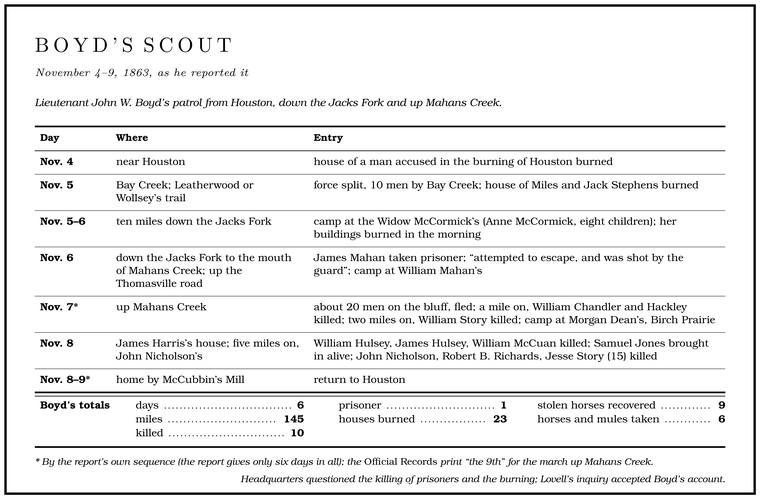
Guerrillas had lately burned much of HoustonNichols 2007, “Fall 1863 in Southeast Missouri”; OR, vol. 22, pt. 1, 749.. On the first day Boyd rode twenty-five miles toward Spring Valley and burned the house of Benjamin Carter, one of two men he named as having helped burn the town. On November 5 he split his force. Ten men under Orderly Sergeant Basket went by way of Bay Creek to the Jacks Fork. BoydRader 2017, ch. 4, citing the 1860 census of agriculture. took the rest “by way of Leatherwood or Wollsey’s trail,” followed a fresh trail of horses to the river, and burned the house of Miles and Jack Stephens, whom he judged to be bushwhackers. A raider named Fed Taylor had stopped there with twenty-five men the week before. Boyd went ten miles down the Jacks Fork, thirty miles in the saddle that dayOR, vol. 22, pt. 1, 746 (Benjamin Carter and Wilson Farrow, “that were engaged in burning Houston”), as printed in Stevens 1991, 61–62., and camped at the Widow McCormick’s, where Anne McCormick lived with eight children. He had “positive evidence,” he wrote, that she kept “a general rendezvous for Freeman’s and Coleman’s guerrillas.” In the morning he burned her buildings.
From her son, a young boy, Boyd learned that James Mahan, probably the twenty-two-year-old sonRader 2017, ch. 4, n. 42 (his text calls James a cousin of Henry’s). of Billy Mahan, had got the boy to carry word of the soldiers’ coming. Boyd sent back for Mahan, took him prisoner, and marched down the Jacks Fork to the mouth of Mahans Creek and up the creek on the Thomasville road. Mahan “attempted to escape, and was shot by the guard.” That night the patrol camped at William Mahan’s, twenty-four miles from the morning’s camp. By one account the camp that night was at Thomas Mahan’s instead, and the soldiers made Mrs. Mahan cook their supperLewis 1980, PDF p. 34, the only source; his later page (PDF p. 61) follows the report and has William Mahan’s. The report dates the march up Mahans Creek “the 9th”; by its own sequence it was the 7th. while they hunted for her husband. The next morning, going up Mahans Creek, they saw about twenty men on the Bluff. A cliff along the river, usually on the outside of a bend, where the river has cut sideways into the hill. In this sense the word was first used in North America (Chapter 2; Chapter 18). Glossary → above them. Boyd’s men fired a few shots, climbed the hill, and found that the men had “fled into the rocky ravines and hills, where it was impossible to pursue to advantage.” A mile farther on the soldiers met three men who ran. They killed two of them, William Chandler, said to be from Dent County, and a man named Hackley, who carried a discharge as a lieutenant of Company F of Mitchell’s Confederate regiment and packets of letters from men in the Southern army and people in Arkansas, addressed to families in Dent and Phelps countiesOR, vol. 22, pt. 1, 746; Lewis 1980, PDF p. 61 (the letters “directed to persons in Dent and Phelps Counties”).. Two miles beyond, they caught William Story on a government horse, “a notorious horse-thief and house-robber,” and killed him when he tried to escape. They camped at Morgan Dean’s on Birch Prairie.
On November 8, heading home, they charged the house of James Harris and found four men at breakfast, “all well provided and packed, going to Freeman.” William Hulsey, James Hulsey and William McCuan were killed. The fourth, Samuel Jones, Boyd brought in alive “on account of his extreme youth and apparent innocence.” Five miles on, at the house of John Nicholson, the soldiers killed Nicholson, Robert B. Richards and Jesse Story, a fifteen-year-old cousinRader 2017, ch. 4. of William Story. They came home by way of McCubbin’s Mill (Chapter 5). Boyd’s totals: six days, 145 miles, ten men killed, one prisoner, twenty-three houses burned, nine stolen horses recovered, and six horses and mules taken.
His report reached department headquarters in St. Louis, and the staff there, writing for General John M. Schofield, asked whether “the conduct of this officer in killing prisoners and burning houses” had been authorized. The district commander at Rolla, General Thomas A. Davies, sent Captain J. LovellOR, vol. 22, pt. 1, 747–49. to Houston to find out by what authority twenty-three houses were burned and whether fiveOR, vol. 22, pt. 1, 747 (Special Orders No. 186). of the dead, six in the later reports, had been killed as prisoners. Boyd wrote an amended report. The Harris house, he said, stood in a lot with a cornfield on one side and thick brush on the other, and his men could not surround it before the men inside saw them and tried to escape through the back yard. The boy Jones took the main road instead of the brush, and two or three riders brought him back. Nicholson’s was a double log house with three outside doors, and the men there ran out through them and were “shot, running,” Nicholson himself after he had got more than half a mile. Lovell accepted his account that the men had “broke for the brush” and were killed that way. Many of the burned buildings were “vacant huts or cabins” used by bushwhackers, hidden in the ravines of the rough country, and in three or four of the houses, Lovell reported, the soldiers had found several barrels of salt and goods taken from robbed sutlers. The rest belonged to the men who had burned Houston and West Plains, which Boyd said he knew from “the dying confessions of Roush” and other evidence. These men, he added, had murdered loyal citizens at their own homes, Wilson Smith of Spring Valley among them, had carried Hackwith and Graham to the Jacks Fork and killed them, and “whilst I was endeavoring to live a peaceable citizen of the county, they have hunted me like a wild beast and tried to kill me for my principles, and that were I again placed in similar circumstances I would do as I have done.” What was done, Boyd wrote, was done “by my sanction and order.” Lovell, back at Rolla on November 24OR, vol. 22, pt. 1, 747–49 (the department’s inquiry and the district’s orders at 747; Lovell’s report, Rolla, November 25, 1863, at 748; Boyd’s statement at 748–49). Schofield then commanded the Department of the Missouri, and Davies the District of Rolla (OR, vol. 22, pt. 1, 313, 569, addressed to him)., found that Boyd had “acted correctly, and for the good of the service,” and the district commander agreed. In the Mahans Creek country Boyd was remembered as a murderous bushwhacker in a Union uniformRader 2017, ch. 4..
December 1863. A scout went out that December after the robbers around Mountain Store, a trading place on the upper river, and on its way back killed a guerrilla named Clark on the Jacks ForkGoodspeed 1889, Texas County, “Military Affairs.”. In the upper river’s own telling the man was called Clarie, and he was killed at Mountain Store itselfLewis 1980, PDF p. 6; see Reach B. (Reach B).
1864. Boyd was back on the river in February 1864, leading thirty men from Houston to Eaton’s on the Jacks Fork, twenty-two miles from the post, and on into Howell and Oregon counties after Freeman. Eaton’s was probably the farm of the Jesse Eaton who had bought land on the river about 1858Goodspeed 1889, Texas County, “Pioneer” (Jessee Eaton’s purchase on Jack’s Fork); the identification is an inference. (Chapter 5). On the way back his men spent a day gathering families to move north, and they brought the families’ wagons through Eaton’s again on February 15OR, vol. 34, pt. 1, 113–15.. On February 18 the commander at Salem, Captain Levi E. Whybark, wrote that Freeman and a leader named Love had six or seven hundred men on Frederick’s Fork in the southeast corner of Oregon County, “clearing out that country, burning all the Union families out,” the families of Union men who had left. It was their old range, with plenty of forage, and he expected them to stay. He thought that if troops from Pilot Knob, Rolla, Salem and Houston were sent in from different directions, Freeman could hardly escape, and he asked for a twelve-pounder howitzer, and reported that a scout he had sent “down on Jack’s Fork” the day beforeOR, vol. 34, pt. 2, 363 (Headquarters Detachment, Fifth Cavalry M.S.M., Salem, February 18, 1864, to Lt. Col. J. A. Eppstein, Rolla; the letter is signed “Captain, Commanding Detachment,” with no name in the printed text, and Whybark then held that command; he wrote that if troops were sent in from different directions “I don’t see how he could escape”). had not yet come back. By one account Federal soldiers caught Joshua Chilton’s son Nelson that year, and he got away with a wound in the arm, and later he and a kinsman were killed when they rode into a patrol on the road up Big Shawnee CreekLewis 1980, PDF p. 79, the only source; see Reach J. (Reach J).
In July Whybark took sixty men into Shannon County after a band reported to be herding stolen horses in the southeast corner of the county. He sent one squad “up Jack’s Fork and Current and Gladden Valley.” That night on Big Creek his men fired into riders who would not identify themselves, and in the morning they came on twenty more men dressed “some with citizen hats and in their shirt-sleeves.” Both parties turned out to be Union militia from Centerville. Whybark’s report from the trip described the river country in the summer of the war’s fourth year: “Plenty bushwhackers on Jack’s Fork. The citizens that live there say there are more in that county now than has been since the war. Fine crops of corn on Current River and Jack’s Fork. Most of the men have been at home and made their crops and now all gone off with Freeman.”
January 1865. Whybark went back in the first week of 1865 with forty-five men, on a report of eighty bushwhackers camped on the Jacks Fork. He found them camped in squads of five to fifteen. His men “scouted out Jack’s Fork Hills,” killed a man at a camp there and another on Birch Prairie, and later fought a squad of eight or ten. In that fight they killed four and wounded two who got away, and one of Whybark’s men was badly wounded. Splitting into three squads, they scouted the whole county and the head of the Jacks Fork, more thoroughly, Whybark thought, than the county had been scouted since the war began. They killed six men in all, took nine horses, and burned camps and “harboring places.” They also found “several pens of corn out in those hills, five miles from any farm.” Whybark thought a scout of two or three hundred men sent down to Spring River in Arkansas, where the bands took what they stole, would pay, and he reported corn enough in Shannon County and below it to feed a force of three or four hundred camped in different places. Freeman had disbanded his men until spring, Whybark wrote, and they were scattered over the country in small squads, some of which had gone north into Texas County and toward Rolla to rob the citizens “of all their horses and bedclothing and meat”OR, vol. 48, pt. 1, 17–18. and left the families they robbed nothing to eat. Some of the guerrillas’ own families, he added, had moved back into Texas and Shannon countiesWhybark’s report, Salem, January 8, 1865 (OR, vol. 48, pt. 1, 17–18), as reprinted in Fort Scott Tribune 2010; the volume itself was not seen for these details. The reprint reads “horses & bed clothing, meat, etc.” where the quotation above, taken earlier from the volume, reads “horses and bedclothing and meat.”.
Neighbors
Between the reports, families did what they could to get through. They hid their provisions, and many men left home rather than wait for a patrol or a band to find them. Union troops treated the hill people as hostile, required oaths of loyalty, and put some Southern sympathizers to work on the roads. Raiders of both sidesStevens 1991, 58–59; Rader 2017, ch. 4. took horses, cattle, hogs and corn, burned houses and barns, and shot men they believed were helping the other side. Old quarrels were settled along with new ones. In March 1865 bushwhackers took Dr. Thomas Reed and two of his sonsStevens 1991, 61, citing Little 1990. from their homes and shot them. The Reeds had been political rivals of the Chiltons.
Horses were the great prize. Horse HollowO’Brien 1939, 62., in Alley Township, takes its name from John Alley’s horses, which raiders tried to steal during the war. Hogs fared better than any other stock. They were hard to catch, quick to breed and able to feed themselves in the woods, and in Delaware Township their numbers held upRader 2017, ch. 4. through the 1860s when every other measure of farm production fell.
Union families left in the night. James Edgar Canavit was thirteen in 1865, when his family, Union people in Shannon County, fled on a dark, wet night after bushwhackers had already killed one man. His father put on women’s clothes to get past the riders. Before they left, his mother took a last look at the spring behind the house and said a prayer for her handmade dishes, which the family had hidden in a cave. They made it to IllinoisRader 2017, ch. 4, quoting Betty Ames, letter to the editor, Shannon County Historical Review, Autumn 1965, 2. and never came back. A granddaughter set down the family’s memory of that night in 1965.
Two stories of a Union household on the Jacks Fork may be versions of one event. In one versionStevens 1991, 59, after Flanders 1979, 210 (the version printed in regional histories)., raiders were coming toward the farm of a Union man. He went into the hills with his older children and left behind his wife, bedfast with newborn twins. The raiders carried the woman and the babies into the yard, where they died of exposure. In the version a descendant gave in the late 1990sGibson 2000, 32–33 (told to a Park Service researcher; the source gives its interviewees pseudonyms)., the family had come to the river in the 1860s and homesteaded on a cliff above the Jacks Fork, upstream from Alley. They were Republicans, and the family remembers that as the reason they were burned out. Men in masks made from sugar and flour sacks came to the house. The father had already left, thinking the raiders wanted only him. The raiders carried the mother out on her feather bed with her newborn twin boys and set them in the yard, loaded the household goods onto the farm’s own wagons, and burned the house and barn. They drove off the sheep, some cattle and a hog. At the first crossing above Alley a wagon broke down, and they burned it there. The mother died of pneumonia. The two tellings agree on the Jacks Fork farm, the Union household, the newborn twins and the bed carried into the yard, and they differ on who died. Neither gives a date or a name that can be checked against a record. A third telling, set on the old Buxton farm above Alley, names the family, Robert and Julianna Powell, and makes the burners Lieutenant Boyd’s militiaLewis 1980, PDF p. 44, the only source; see Reach G. The three tellings are not shown to be one event. (Reach G). Violence against women and children was rareStevens 1991, 59. even in this war.
A county without a government
Shannon County government stopped for most of the war. In Missouri the county court was less a court of law than the county’s governing boardgeneral (the Missouri county court of the period)., three judges who set the taxes, laid out the roads, paid the county’s bills and looked after its poor, and when it stopped meeting the county’s government stopped with it. The court did not meet from its December term of 1861 until October 1866. The county collected no taxes, and it held no elections in 1862 or 1864. The courthouse at the old county seat on the Current burned during the war. Some accounts blame Union soldiers or militia, perhaps in return for the burning of the Texas County courthouse at HoustonRader 2017, ch. 4., and others say only that it was burned by persons unknown sometime after 1863Eddleman 2022..
Stories gathered around the county’s money and records. One says the treasurer, Alexander Deatherage, buried the county’s funds on his farm in Spring Valley, went off to fight for the Confederacy at Wilson’s Creek and Lexington, and dug up the money after the war and handed back two thousand dollars, or four thousand in another telling, in gold and silver. The story is probably apocryphal, since versions of it are told in other counties, but Shannon County voters kept electing DeatheragesRader 2017, ch. 4 (the judgment that it is probably apocryphal is his). to county office for years. Another account has the county’s records hidden in a caveRader 2017, ch. 4, n. 39, citing an undated manuscript by Oscar Harper., and by a third, court sat for a time in a caveO’Brien 1939, 42–43. near the old seat after the courthouse burned. In 1866 and 1867 the county’s officers apparently worked out of their homes and a log house on Billy Mahan’s farm, until the county court moved the seat to the Jacks Fork in 1868Rader 2017, ch. 4. (Chapter 5). By one account the officers elected that year were George F. Chilton, sheriff and collector; John M. Daugherty, circuit and county clerk; Alexander Deatherage, treasurer; and David C. Reed, assessor and representative. By the same account the first business house in the new town was built by Deatherage and a Colonel Thomas Freeman, who kept a store and a saloonLewis 1980, PDF p. 64, the only source. Lewis does not say whether this Freeman was Thomas Roe Freeman, the Confederate colonel of the war years; the same page has a Thomas Freeman later keeping a store in a log building on the square. in it.
Caves, a tree and a sign
Caves in the riverways were used during the war, or are said to have been, as sources of saltpeter, the potassium nitrate that makes up three-quarters of black powder, made from nitrates leached out of the dry earth of cave floors, as places to recover, as hiding places for records, and as refugesThornberry-Ehrlich 2016, 3. What saltpeter is and how it was won from cave earth is general.. The Canavit dishes, hidden in a cave somewhere in Shannon CountyRader 2017, ch. 4 and n. 27. according to family memory, are one of the few specific examples. The river’s two best-known war caves have thinner records. The story of a field hospital in Hospital Cave, in the bluff above Blue Spring, can be followed back no further than a hand-lettered sign a floater saw in the mid-1930s, probably 1934Dorrance 1938, 29, the earliest source found; the year is reckoned from the weekdays and dates Dorrance gives for the float, which fit 1928 as well., and the legend that both sides hid out in Meeting House Cave, below Jam Up, no further in print than a Park Service folder of 1977NPS 1977, the earliest printed source found. (Chapter 13).
The Chiltons have a tree. North of present Eminence, on what was the Joshua Chilton farm, stood the Civil War Oak. By tradition, guerrillas caught Alex Chilton, Joshua’s brother, with four companions and gave them “a sporting chance” to run for their lives. The four were shot, and Alex climbed into the oak and hid until the raiders left. The deedO’Brien 1939, 28 (the tradition as recorded in 1939). to the farm forbade cutting the tree. The story resembles the killing on the Rolla road in 1862, where one of six prisoners got away, but in that event the man who escaped was Jackson Heron and an Alexander Chilton was among the dead. The family was large, and an Aleck Chilton helped murder a storekeeper near the Reynolds County line in February 1863Fellman 1989, 23–24; Nichols 2007, “Winter 1863 in Southeast Missouri.”, so the tradition may belong to another man or another day. By another telling, Alex Chilton was at his aunt Betsy Chilton’s when soldiers rode up. He ran into the cornfield, knocked one rider from his horse with an ear of corn, pulled off his boots and climbed into an old vine-covered oak, and the soldiers found his shoes but not him; he spent most of the nightLewis 1980, PDF p. 75, the only source for this telling, which gives no date. in the tree. A man of that name lived through the war, for by the same account an Alex Chilton was shot dead at Powell Spring in 1879 by his uncle, Andy ChiltonLewis 1980, PDF p. 74 (March 25, 1879), the only source; see Reach J. Whether the oak’s Alex and the man of 1879 were one man is not shown. (Reach J). Shannon County’s war names, Horse Hollow, Hospital Cave and the Civil War Oak among them, are tied to things that happened, or are said to have happened, in the county itself, where in Dallas County, north of Springfield, the war’s names went on townships honoring Sheridan, Sherman and GrantO’Brien 1939, 155 (in Shannon “the names touch common life more closely,” and they “reflect a deeper sense of participation in the War itself”)..
After the surrender
The surrender in 1865 did not bring peace to the hills. Discharged soldiers came home to burned houses, and HoustonNichols 2007, “Fall 1863 in Southeast Missouri”; OR, vol. 22, pt. 1, 749. and West Plains had been burned out. Guerrillas had burned every building in West Plains, and Howell County, which had held about 3,200 people before the war, was down to about fifty familiesStevens 1991, 63, after Goodrich and Oster 1986, 295.. Salem fell from about seventy-five families to twenty-five. Across Missouri perhaps a third of the people moved out of the stateStevens 1991, 64. during the war. In Shannon and Oregon counties armed bands, a mixture of Union deserters and Confederates who had never given up, kept the civil law from returning. The best known, led by a Colonel Jamison, numbered about fifty men, and it went after discharged Union soldiers. In Texas, Shannon, Oregon and Howell counties secret societies guarded the farms of Confederate veterans that were being sold for back taxes, running off or killing anyone who tried to move onto them. Southern sympathizers in Oregon and Shannon counties formed a Secret Order of the Sons of LibertyStevens 1991, 63, after Goodrich and Oster 1986.. Union men who had fledStevens 1991, 63–64, after Goodrich and Oster 1986 (the letters of Daniel Fogle, August–September 1867). the Southern counties were still gathered around Rolla in 1867, afraid to go home. A Pennsylvanian looking for land in the region that year found “few men but many widows.”
In the fall of 1867 Governor Thomas Fletcher declared martial law in the two counties and commissioned William Monks of Howell County as a major of state troops, with orders to drive out the bands in Oregon, Shannon and Dent counties. Monks raised a company of men who had served on both sides, surprised a meeting of the Sons of Liberty on the Warm Fork of Spring River and seized its papers, and broke up Jamison’s bandMonks 1907, 173–79; Stevens 1991, 63.. His men marched through Shannon County, apparently without meeting resistanceRader 2017, ch. 4.. Civil law was restored that DecemberStevens 1991, 63., and the hard feelings took years longer to fade.
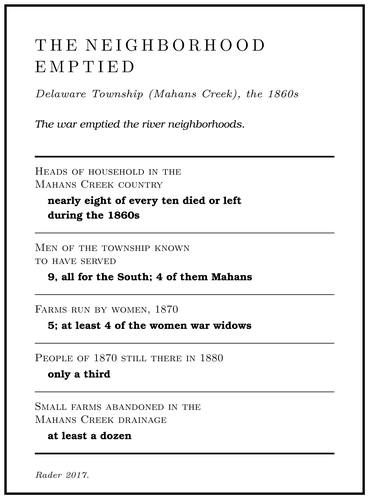
The war emptied the river neighborhoods. In the Mahans Creek country nearly eight of every ten heads of household died or left during the 1860s. The 1870 census of Delaware Township counted five farms run by women, at least four of them war widows, and the war nearly wiped out the men of the Mahan family. Only a third of the people living in the township in 1870 were still there in 1880. At least a dozen small farms in the Mahans Creek drainage had been abandoned, and in 1880 they could be had for almost nothingRader 2017, ch. 4.. In 1925 an old-timer complained in the Eminence Current Wave that the people had been “milked dry and bled white.” In 1868, asked whether he was the wisest man in Shannon County, the county’s newly elected representative, David C. ReedRader 2017, ch. 4, quoting the Current Wave, June 25, 1914., answered, “No but I am the only man there that has shoes to wear.”
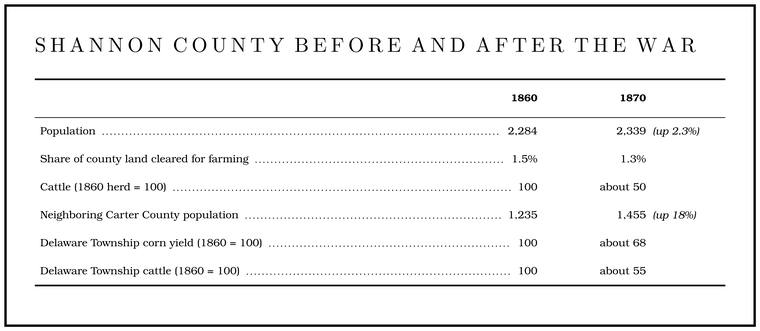
The census figures for the county show the same damage (Table 6.1). Missouri as a whole grew by nearly half in the 1860s as settlers poured in, and a state board of immigration set up in 1865Stevens 1991, 64. worked to Draw. A valley, in the usage of the Eleven Point side of the divide in Howell County (Chapter 18). Glossary → more of them and make up the losses. The southeastern Ozark counties together grew about 4 percent, and Shannon County grew by 55 people. Its farms and improved acres both declined. Its cattle herd fell by half, and in Delaware Township corn yields fell by about a third. Livestock had been the hill farmer’s main wealth, and herds took years to rebuild.
Politics went back to where they had been before the war. The state constitution of 1865, written by Missouri’s Radical Republicans, required every voter and officeholder, and even lawyers, teachers and preachersgeneral history (the test oath of the Missouri Constitution of 1865)., to swear an oath that he had never aided the rebellion in any way, which shut out former Confederates and anyone who had helped them. In 1867 the secretary of state threw out Shannon County’s vote for a pro-Southern state senator. In 1870, as the restrictions were lifted, the Democrats, led by the Chiltons, took back control of the county. George F. Chilton went to the legislature, and three Confederate veterans from Delaware Township became county clerk, sheriff and assessor; the assessor, Henry Bayne Catlett, was married to Billy Mahan’s daughter Margaret. No Republican in the county drew more than twenty votes that year. For years afterward a known Union man could not win county office, the Eminence Current Wave called itself “A Democratic Newspaper” and praised candidates’ Confederate service, and the county’s Confederate veterans were still holding an annual reunion in 1897Rader 2017, ch. 4..
Among the war’s lasting effects in Shannon County was a deep disturbance of the county’s prewar sense of communityStevens 1991, 65, after Flanders 1979, 215–16 (Flanders’s judgment).. In the Mahans Creek neighborhood the war deepened an already entrenched wariness of strangers and a habit of relying on kinRader 2017, ch. 4. before neighbors. Other consequences took longer to show. Union soldiers probably carried home word of the rich forest and mineral resources of the Current and Jacks Fork country, and within a generation outside lumber companiesStevens 1991, 65. came to cut them (Chapter 7). A century later, when the federal government came to buy the riverbanks, the distrust it met had nearer causesGibson 2000, ch. 3, which ties local mistrust of government to the Park Service’s land buying. (Chapter 10), though the war had taught the county to reckon outsiders by their side.