The people who grew up along the Jacks Fork used the same few Pool. A deep, slow stretch of river between riffles (Chapter 16). Glossary → the year around. The children swam in them and jumped from the Bluff. A cliff along the river, usually on the outside of a bend, where the river has cut sideways into the hill. In this sense the word was first used in North America (Chapter 2; Chapter 18). Glossary → above them, the churches walked their converts down into them, and in winter men poled Johnboat. A long, narrow, flat-bottomed, square-ended boat, poled, paddled or motored. It was the guide boat of the Eminence outfitters and is still the fishing and gigging boat of the river. The word is in print from 1894 (Chapter 9; Chapter 18). Glossary → over them after dark and speared suckers off the Bottom. The flat land along a river or creek, built of its deposits and open to its floods. In the 1920s the bottoms near Eminence averaged about a quarter of a mile wide (Chapter 2; Chapter 5). Glossary → by firelight. When people set out for the water, a Mountain View resident remembers, what they said was “Going to the river.”
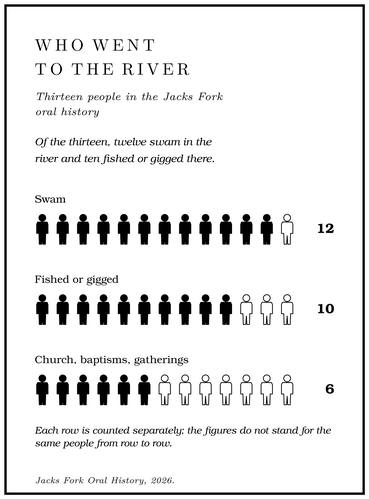
Of thirteen people who have told of their years on the river, twelve swam in it and ten fished or gigged there. SixJacks Fork Oral History, records SV-03 to SV-25 (thirteen records name what people did on the river: swimming in all but SV-23; fishing or gigging in SV-03, -05, -06, -09, -15, -19, -22, -23, -24 and -25; church, baptisms or gatherings in SV-06, -09, -15, -20, -22 and -25). named church, baptisms and gatherings among the reasons they went.
Learning the water
Old-timers of the Riverways country, looking back in the late 1990s, spoke of having “lived on the river”Gibson 2000, 41 (old-timers interviewed for the Park Service in the late 1990s). as children. Everyone who lived along it kept an old boat or two tied upGibson 2000, 37., one man remembered, though none of them had motors, and he and his cousins spent “a lot of time on the river, swimming and fishing.”
In Eminence a whole generation learned from Luther RowlettGibson 2000, 41–42 (an interviewee who learned from him as a child in Eminence; no dates are given).. After he came back from the army, one of his pupils thought, he never held a job in town again. He never married, wore an old pith helmet and called himself a “Retriever,” because he spent his days searching the river bottom for the valuables that floaters lost when their canoes turned over. He could stay under so long that the children sometimes thought he had drowned. He made them diving gear by setting glass into the bottoms of buckets, wrote little pieces for the newspaper, and hitchhiked to Florida for the winters. “Luther taught us all to swim,” the same pupil said. Parents slipped him a little money now and then, “because he was kind of like the Pied Piper. The town babysitter actually.”
Farther up the river a Chicago writer whose family bought a Texas County farm north of the river in 1935Lyon 1941 (Marguerite Lyon), about a farm bought in 1935; see Chapters 8 and 9. (Chapter 9) learned the water from her neighbors. The farm lay about a mileLyon 1941, 42. from what everyone there called “Jack’s Forks.” “It was nice,” she wrote, “but it didn’t run through our farm.” A neighbor girl knew to the drop how much rain it took to flood a Branch. A small creek. The sense is American, on record from 1674 (Chapter 18). Glossary → at Barn Hollow to swimming depthLyon 1941, 150., and after a wet spell the family swam thereLyon 1941, 294.. When a carload of boys and girls with “wet stringy hair”Lyon 1941, 213. came rattling up the hill to an old woman’s gate on the way home from swimming in Jack’s Forks, she muttered about “Sech goin’s-on.”
Decades later a writer who homesteadedCarey 1994, 22 (Ken Carey). in the hills near the river used a pond on his land, formed in a basin of stone with warm shallows, for “preparing our toddlers to swim in the nearby Jacks Fork River.”
The swimming holes
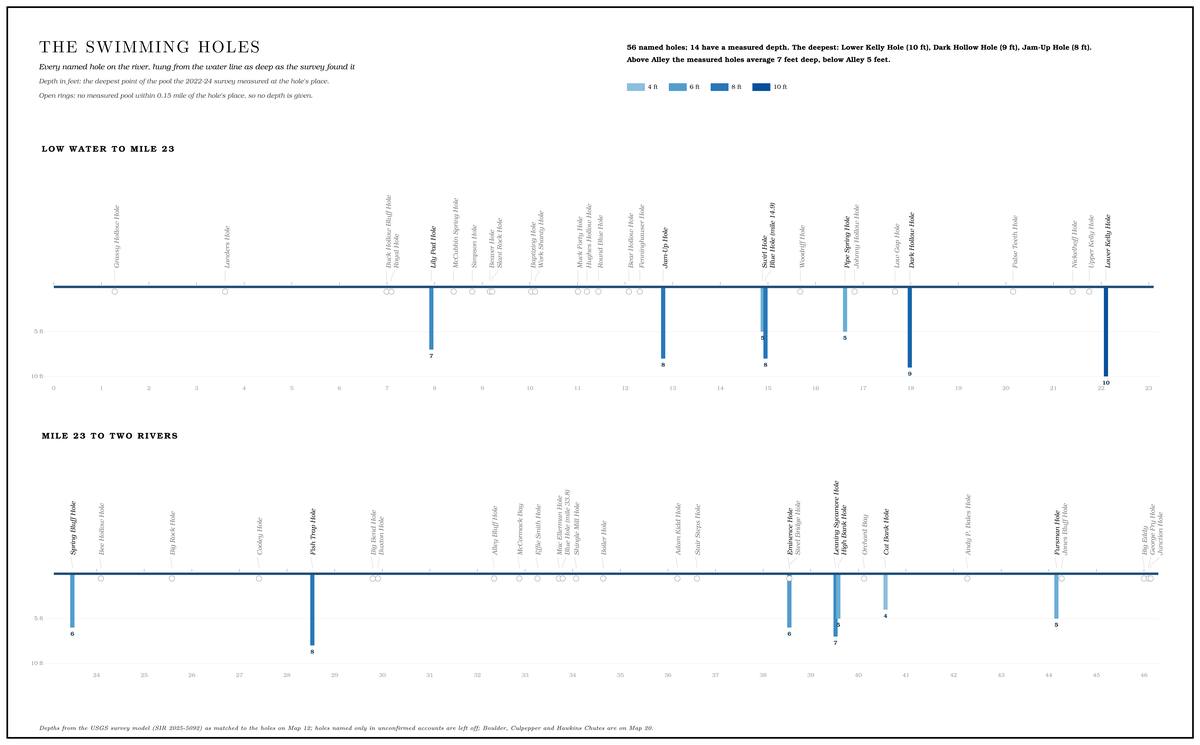
A Jacks Fork swimming Hole. Any pool deep enough to swim or fish in, named or not, the basic unit of the river in local speech; also “hole of water” (Chapter 18). Glossary → is nearly always the same arrangement. The river swings against a bluff on the outside of a bend, where the current runs fastest and scours its bed deepest, and keeps a deep pool at the bluff’s foot. On the inside of the bend the water slows and drops its gravelsee Chapters 2 and 15., building a bar that slopes gently into the pool. The bar is where people go in, sit and watch, and the bluff is what they jump from (Chapters 2 and 15). At the lower end of the pool a Riffle. A fast, shallow, rocky stretch between pools. The riffles are the gardens of the riverbed: in July a square meter of riffle produced more than six times as much as a square meter of pool (Chapter 16). Glossary → of coarse gravel crosses the channel like a low natural dam and holds the water upsee Chapter 15. when the river falls. Measured on the riverbed survey of 2021–23, the deepest pools lay 8 to 10 feet below the riffles that hold them, and that is roughly how deep they stand at Low Water. The local name for the Highway Y bridge over the South Prong, the access beside it and the county’s low-water crossing where the prongs meet, and so for the head of the river (Chapter 8; Chapter 18). Glossary →. Among them are Lower Kelly Hole, about 10 feet, Dark Hollow Hole about 9, and Jam-Up Hole and Fish Trap Holeeach pool’s depth below the riffle that holds it, measured on the 2021–23 riverbed survey (Heimann, Atkinson and High 2025; Map 12); see Reaches E, F and G., about 8 (Map 12).
On the Forks, the. The North and South Prongs and their junction, where the Jacks Fork begins; also called the Prongs (Chapter 18). Glossary →. On the North Prong a Mountain View resident who grew up at Arroll spent “most summer afternoons” at Pebble Rock Dam, several miles above the junction where Arroll Road crosses the North Prong near the Houston Rural Cemeterysee Reach A., “with the rest of the people from that area.” The resident remembers a dam, a bridge and a swimming hole with “a large rock to jump off of”Jacks Fork Oral History, record SV-20 (marked on a map at the dam); see Reach A. (Reach A). The same resident’s memories of Dixon Fordsee Chapter 11. on the South Prong, closed by its new owners, are in Chapter 11. At Low Water, where the Highway Y bridge crosses the South Prong a short way above the junctionsee Chapter 8., the new bridge “changed the river and the swimming hole quite a bit”Jacks Fork Oral History, record SV-20; see Chapters 8 and 15. (Chapters 8 and 15).
Steel Bridge and Blue Spring. At the Highway 17 bridge the swimming was along the bluff, with a Gravel bar. A bank of chert gravel and sand, usually on the inside of a bend, bare at low water (Chapter 15; Chapter 18). Glossary → to go in from and several places to jumpJacks Fork Oral History, record SV-20; see Chapter 15 and Reach D. (Chapter 15; Reach D). A Mountain View swimmer who grew up in the town spent every summer day of 1984, 1985 and 1986Jacks Fork Oral History, record SV-06. there. A Howell County columnist’s family preferred Ratliff Ford, a short way upstream, unless they were camping at AlleyWhitaker 2025 (Lonnie Whitaker, writing in the Howell County News).. Below Steel Bridge, Blue Spring had its jumping rock, and the old resort at the bridge had its own jumping bluffsee Reach D and Chapter 15. (Reach D). Both holes have changed since the 1990ssee Chapter 15. (Chapter 15).
Rymers. The same Mountain View swimmer camped at Rymers as a child and remembered getting there in an uncle’s Jeep, across the neighbors’ fieldsJacks Fork Oral History, record SV-06..
Alley. In 1926 and 1927, soon after the state bought Alley Spring for a park, it built a swimming hole with a beach and a beach house on the Spring branch. The stream that runs from a spring to the river, such as the branch below Alley Spring (Reach H). Glossary →Stevens 1991, 182 (after the Annual Report of the State Game and Fish Commissioner, 1926 and 1927); see Chapter 9 and Reach H. (Chapter 9; Reach H). The river nearby had its own holes. Someone who grew up in Eminence, born in 1967Jacks Fork Oral History, record SV-15 (marked on a map at Bluff Hole)., swam “all along the Alley access from Bluff Hole all the way down to where Alley Spring runs into the river.” Bluff Hole, a short way upstream of Alley, was the jumping place: “Tall bluff with well beaten paths to the top, where we jumped off the bluff. With a big sand bar on the other side for people to watch.” A Birch Tree resident born in the 1940s named Bluff HoleJacks Fork Oral History, record SV-25. too. Lynne Norris of Winona, who swam there in the 1970s, listed “Bluff Hole, Button Rock, in Eminence at the bridge, about anywhere you wanted to.” When she went back, Bluff Hole was “about gone.”
Eminence. In town the boys’ hole was Button Rock, near the Circle B campgroundJacks Fork Oral History, records SV-12 and SV-20 (marked on maps).. Old-timers knew it as a boys-only swimming hole and called it the Naked HoleGibson 2000, 41., after what the boys preferred to wear. Lynne Norris has heard it spelled both Button and ButtinJacks Fork Oral History, record SV-17; SV-12 wrote “Buttin Rock.” (Chapter 18). In the late 1990s a favorite riverside hangout for Eminence young people was the old Pickin’ and Grinnin’ campground, by then renamed Jack’s Fork campgroundGibson 2000, 75.. Below town a big gravel bar above Lick Log Hollowsee Chapter 17. drew boaters and swimmers to stop and picnic (Chapter 17).
Jumping
Every hole with a bluff had a jumping place, and children measured themselves against it. At the old resort below the Highway 17 bridge it was a rite of passage for the youngest guests to swim across, climb the bluff and belly-flopsee Reach D (Wehmer 2024). off it (Reach D). At Bluff Hole above Alley the paths to the top of the bluff were “well beaten.” At Pebble Rock Dam there was a big rock to jump from and a rope swingJacks Fork Oral History, record SV-20. that the Mountain View resident who grew up there calls “treacherous.”
The Howell County columnist floated the river in the 1960s in a homemade fiberglass canoeWhitaker 2025 (the canoe built by Royce Yardley and his father). that a friend and his father had built. As “reckless daredevils,” he remembered, “we often jumped from overhanging trees or ridiculously high bluffs.”
Gravel movessee Chapter 15. in every flood, and water deep enough under a bluff one summer may be shallow the next (Chapter 15). The park’s rules on jumping and rope swingssee Part Six. are in Part Six.
Down to the water
The churches of the Jacks Fork country are mostly evangelical Protestant. By 1906 four denominations, the Baptists, Methodists, Disciples of Christ and Cumberland Presbyterians, counted more than 83 percent of church members in the interior counties of the Ozarks, and Baptists and Methodists alone made up more than three-quartersBlevins 2021, ch. 4. of churchgoers in sixteen counties. The Baptists and the Disciples baptize by immersion. The convert, old enough to profess the faith, is laid back under the water by the preacher and raised up again, all the way under, as a sign of burial and rising, so the water has to be deep enough to take a grown person. Before a congregation had an indoor baptistrythe practice of the Baptist and Disciples churches, given as general explanation., a tank built into the church for the purpose, the nearest deep water was the river. In rural Missouri between 1885 and 1910 a Baptizing. A baptism by immersion in the river. Between 1885 and 1910 a baptizing in rural Missouri drew a neighborhood out much as a picnic did, and Buck Hollow Ford and Baptizing Hole were places for it (Chapter 19). Glossary → was also a public event. It drew a neighborhood out much as a picnic did, or a debate, a program at the close of the school term, or a brush-arbor revivalGilmore 1984 (publisher’s description, which sets baptizings among the public diversions of rural Missouri with picnics, brush-arbor revivals, debates and closing-of-school programs). held under a roof of poles and leafy boughs.
A baptizing in the Jacks Fork might follow a day of snow. Buck Hollow Ford, where Highway 17 crosses today, was a natural place for one, a broad, rocky crossingsee Chapter 8. that a congregation could walk into (Chapter 8), and it seems to have served as a baptizing place in all weathers into modern timesWehmer 2024, the only source (the ford “seems to have been used in all weathers into modern times as a baptizing hole”).. At a river baptizing the preacher usually stood about waist-deep and the candidates waded out to him one at a timethe usual order of a river baptizing, given as general explanation; Wehmer 2024 pictures the candidates walking out “waist-deep” to wait their turn.. The Ford. A place where a road crosses through the water. Many of the river’s fords took the names of the families who lived beside them (Chapter 8). Glossary → is above Blue Spring, where the river takes its temperature from the weather, and in 2012 the water at the bridge fell as low as about 36°Fsee Chapter 16 and Reach D. (Chapter 16).
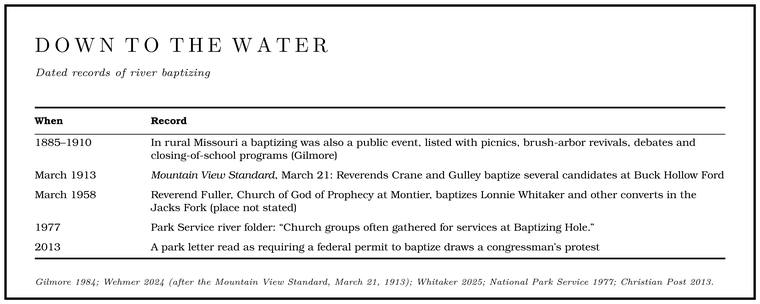
A record of one baptizing at the ford survives in a short notice in the Mountain View Standard of March 21, 1913, headed “Baptists Baptise Sunday.” Reverends Crane and Gulley had baptized several candidates at the ford. “Owing to the threatening weather that morning,” the paper reported, “few thought there would be any baptizing, and there was a smaller crowd present than usual.” The “than usual” suggests that a baptizing at the ford ordinarily drew a crowd. The next Arroll column reported another light snowWehmer 2024, quoting the Mountain View Standard, March 21, 1913. on the Saturday before.
Mountain View, whose paper printed the notice, had a Baptist church of its own. It was founded in 1875 as Mount Olivet Baptist Church, though its own records begin only with a reorganization in 1906. In 1913 it left the Union Baptist Association for the newly organized Howell County Baptist Association, and in 1938 it took the name First Baptist Church of Mountain ViewSHSMO R987 (the collection’s description of the church’s centennial booklet of 1975: founded as Mount Olivet in 1875; “no records exist prior to reorganization in 1906”; in the Union Baptist Association until 1913, when it joined the newly organized Howell County Baptist Association; renamed in 1938; the booklet itself not seen). Nothing in it ties Reverends Crane and Gulley to this congregation..
On a chilly Sunday afternoon in March 1958Whitaker 2025 (the “Jacks Fork dunking”; he does not say where on the river)., Reverend Fuller, pastor of the Church of God of Prophecy at Montier, baptized several converts in the Jacks Fork. One of them was the Howell County columnist, who had asked whether baptism was required for salvation and never got a specific answer. After Brother Fuller’s “fiery sermons,” as he put it, “I did not want to take any chances. Apparently, neither did he.” Where on the river the baptizing took place is not recorded. The memory comes back to him every spring, when he drives home from the family graves at Montier and detours up Highway 17 to Buck Hollow. Years later he joined the Baptist church in Willow Springs, and its pastor, Floyd Gentry, baptized him again in the baptistry behind the choir loft, “apparently” not trusting the Jacks Fork dunking. “Perhaps,” he added, “he was not taking any chances either.”
The river’s best-known baptizing place, by its name, lies near Blue Spring, where the old valley road came down to a wide, level bank. A Park Service folder of 1977 told floaters that the road “seemed to pause at this wide level bankNPS 1977, Jacks Fork stop 2. and invite the community to Basket dinner. A meal that families brought in baskets to share at a church gathering on the riverbank (Chapter 19). Glossary → and camping recreation. Church groups often gathered for services at Baptizing Hole.” Four people who know the upper river still call it Baptizing Hole (one says Baptism Hole), and the two who have marked it on a map put it below the springJacks Fork Oral History, records SV-06 (“Baptism Hole”), SV-12 (“Baptising Hole, Bachers”; not marked on a map), SV-20 and SV-23 (marked on maps at about miles 10.6 and 10.1 on the river centerline, below Blue Spring at 9.8; the federal place-name record puts Baptizing Hole at about 10.0). See Reach D. (Reach D).
Baptizings in the river did not end with the old roads. The Mountain View resident who grew up at Arroll has a daughter who was baptized in the Jacks ForkJacks Fork Oral History, record SV-20 (“My daughter was,” of anyone baptized in the Jacks Fork).. On the Current, a Van Buren resident remembered “big baptizings”Gibson 2000, 45 (a Van Buren resident). among the carnivals and get-togethers of earlier days, as part of a time when there were “just more gatherings and more love and more care for each other.” When a letter from the park in 2013 was read to mean that churches needed a federal permit to baptize in the river, it drew a protest from the district’s congressmansee Chapter 10. (Chapter 10).
The river at night
A gig is a spear, an iron head of three or four barbed tines, forged and tempered by a blacksmithTurner 2014. and socketed onto a wooden pole, often of pine and as much as fourteen feet longRandolph 1931, 231 (pine poles about fourteen feet long, in the southwestern Ozarks).. Gig, gigging. A gig is a spear of three or four barbed iron tines on a pole as much as fourteen feet long. Gigging is spearing fish with it from a boat in clear, shallow water, chiefly suckers, by night under lights or by day (Chapter 19). Glossary → is spearing fish with it from a boat in clear, shallow water. The quarry is suckers, chiefly the northern Hog sucker. The northern hog sucker, a bottom fish with a broad head that turns over the stones of the riverbed with its snout; also called hog molly. It is one of the giggers’ main fish, along with their “yellow sucker,” chiefly the golden redhorse (Chapter 19). Glossary → and the redhorses that Ozark giggers call yellow suckersTurner 2014.. Suckers are bottom fish. The hog sucker has a broad head with its mouth set underneath, and it feeds by turning over the small stonesthe habits of the northern hog sucker, given as general natural history; the river’s fishes are in Chapter 16. of the riverbed with its snout for the insect larvae beneath them, so it stays on the bottom, where a light from above can show it. Its coloring makes it almost invisible against the gravel it lives on. Most hog suckers run 8 to 15 inches long, and one may live eleven years. Smallmouth bass, longear sunfish and minnows often trail a feeding hog sucker to pick up what its rooting stirs loose. It goes by hog molly and box head as well, and its big, bony head leaves less meatMDC, “Northern Hog Sucker” (its coloring “makes it almost invisible” on a gravel bed; 8 to 15 inches, at most about 17; “can live for 11 years”; other names hog molly and box head; smallmouth, longear and minnows “commonly follow foraging hog suckers”; a less desirable food fish because its bony head is much of its body). on it than other suckers carry. The giggers’ yellow sucker is chiefly the golden redhorse, a fish of about the same size and lifespan that forages for the larvae of midges, mayflies and caddisflies on the bottoms of pools, and much of the redhorse harvest by gig and snag in Ozark streams is golden redhorse. The black redhorse, which some call the white suckerMDC, “Golden Redhorse” (other names yellow sucker and golden sucker; 9 to 15 inches, living 11 years or more; “Much of the gigging and snagging harvest of redhorse suckers in Ozark streams is of this species”; the black redhorse, “white sucker,” is included in that harvest)., is taken too. Which fish may be gigged, and whensee Part Six., is set out in Part Six.
The gigger has to see the fish on the bottom before he throws, and that needs water as clear as it runs here, which is one reason the Jacks Fork and the Current are among the few places in the countryGibson 2000, 74. where gigging is still done regularly. Gigging began as a way to feed a family through the lean months of winterTurner 2014., and because the season falls in the cold months, after the tourists have gone, it has stayed a local kind of fishingGibson 2000, 74 (“Because gigging takes place in the Winter, that is, in the low tourist season, it is a purely local mode of fishing”).. “When the water’s hot, the fish are no good,” an old gigger of the Eminence country said, and by his rule a sucker has to come out of very cold water to be good to eat.
The suckers have their own season too. Hog suckers spawn in April or early May near the heads of gravelly rifflesMDC, “Northern Hog Sucker.”, and in spring suckers crowd onto the shallow gravel Shoal. A fast, shallow, rocky stretch between pools; a riffle. Suckers crowd onto the shoals in spring, and the old saying is that “the dogwoods bloom when the suckers are shoaling” (Chapter 18; Chapter 19). Glossary → at about the time the dogwoodsthe spring spawning run of suckers on gravel shoals, given as general natural history. flower in the woods above the river. In the late 1990s several people in the Riverways country gave the same sign for it: “The dogwoods bloom when the suckers are shoaling.”
Fire fishing. The method is as old as settlement. By one account nothing archaeologists have found shows gigging in this country before the settlers came, and the settlers had made it common by the middle 1800s, bringing the gig from the southern Appalachians, where it had been used mostly for frogs and small gameRochon 2010, 3–4 (after Bilger 2000, Everts-Boehm 1996 and Hastings 2008; it names the settlers as Scots-Irish), the only source; held to “by one account.”. A gigger of the Eminence country, seventy-four in 2011, whose great-great-grandfather came to the area in 1820, believed that people had gigged these fish for food ever since the first settlers reached the riverWohleber 2011 (“from what records I’ve got, it was going on back then”; he believed people had gigged the fish for food since settlers first came).. When the big sawmills closed in the early twentieth century (Chapter 7), many men left without work are said to have turned to giggingRochon 2010, 4 (after Hastings 2008: lumber-mill closures in the early 1900s left many men without work, and many gigged to support their families), the only source; see Chapter 7. to feed their families. Hunters floated furs downriver in dugout canoes twenty to thirty feet long, and settlers later made the dugout over into a plank-built gigging canoeStevens 1991, 50; see Chapter 9.; the johnboat’s history is in Chapter 9. Old-timers in the Riverways country called night gigging “fire fishing,” and one man remembered how it went. In the afternoon they poled the boat a mile and a half or two miles upriver, and as they drifted back down after dark they kept a fire going in the middle of the boat, in a fire box or metal basketTurner 2014 (pine knots burned “in metal baskets”). they called a “firejack,” with Pine knot. The base of a pine limb where it grows into the trunk, so full of resin that it outlasts the rest of a dead tree and burns hot and bright. Pine knots lit the gigging boats, burning in a fire box or metal basket called a firejack in the middle of the boat (Chapter 19). Glossary → they had split that day. A pine knot is the base of a pine limb, where it grows into the trunk, so full of resingeneral explanation. that it outlasts the rest of a dead tree, and it burns hot and bright for a long while. “That was the only light you had.” A Park Service folder of 1977 told of the same arrangement on the Jacks Fork, with pine knots “burning on clay mud in the middle of their John Boat,” the clay presumably keeping the fire off the boards. The best-known gigging story on the river, of the man who fell overboard at Muck Fortysee Chapter 18., goes with the hole’s name (Chapter 18).
Getting upstream took two men. A Carter County boatbuilderGibson 2000, 39–40. described the poling, one man in the bow keeping the boat pushed off the rocks and the other in the stern supplying the power, two men who knew their business being “more good than a dozen men a trying.” On the Current, by his account, he and a friend once poled a boat home about twenty miles upriver between seven in the morning and noon, with poles about ten feet long that they cut on a gravel barGibson 2000, 40, the only source (the same man, poling a friend’s boat home up the Current from below Gooseneck; “generally it’s 20 miles”)..
On the Black River, east of the Current, Ward Dorrance, whose float down the Jacks Fork is told in Chapter 9, watched a gigging boat come downstream one night, probably in 1934. A bearded man stood bare to the waist in the prow, holding a three-tined gig “strapped to the wrist with a deer-hide thong.” Amidships a ball of wire on a pole held the fire, and the steersman, white with ashDorrance 1938, 19–20; see Chapter 9., doused his head with river water and poled among the rocks (Fig. 19.1after Dorrance 1938, 19–20; Gibson 2000, 38–40; NPS 1977, stop 3.).
Brighter lights. The fire gave way to kerosene lamps fixed to the bow, then to gasoline burners on a pipe that spewed fire on both sides, and then to electric lightsGibson 2000, 39., powered first by gas generators and more and more by batteries running LED lights, which do away with the noise of a generator. The gigger whose family came in 1820 remembered his family going out with gas lanterns, in wooden johnboats that had no motorsWohleber 2011.. By 2010 a typical gigging trip ran at night in a johnboat with a gasoline engine and halogen lampsRochon 2010, 1 (“typically” at night from a johnboat with a gasoline-powered engine and halogen lights).. Giggers set the lights at the front of the boat with a shield over them, so that the fish look up into the glare and cannot see the men behind it. “It’s just like lightin’ up the river bottom,” one gigger explained, “but the fish can’t see past the light and the shield.” The jet motor opened the shallows. It has no propeller hanging below the hull; an impeller inside the housing Draw. A valley, in the usage of the Eleven Point side of the divide in Howell County (Chapter 18). Glossary → water in through a grate and drives it out astern, so the boat can run riffles only inches deep. That made the shallow rivers far easier to get around on, and it helped turn what had been winter food-getting into a sportTurner 2014 (jet motors have no propeller and “use an internal impeller”; they made shallow rivers easier to navigate and “helped turn gigging into sport”); the working of the jet unit given as general explanation.. The modern gigging boat is usually a flat-bottomed johnboat with a jet motor, a bright light and a railTurner 2014 (battery systems running LED lights; “eliminating generator noise adds to the evening’s enjoyment”). across the bow for the gigger to lean on. When the Park Service set new motor limits on the upper rivers, it kept them open to motors in gigging seasonsee Chapters 10 and 11. (Chapters 10 and 11).
The throw. Water bends lightGibson 2000, 38 (“you’ve got to take that refraction in the water”). where it crosses the surface, so a fish on the bottom lies deeper than it looks from the boat, and a pole seems to kink where it enters the water. “You anticipate where the fish is gonna be, not where the fish is at,” the same gigger said, allowing both for the bend and for the fish’s movement. The gig is tied to a string, and if he misses, a hard jerk as the gig reaches the end of its run brings it back to throw again. At night the light dazzles the fish and slows them. By day they can see the boat and the man in it, and moving from night gigging to day gigging, he said, “It’s kind of like going from high school to college.” A folkloristRandolph 1931, 230–33 (Vance Randolph, on the southwestern Ozarks). living in the southwestern Ozarks around 1930, who had once denounced giggers “as loudly as anybody,” watched daylight gigging in still pools four to six feet deep and found it “more like shooting quail on the wing with a small-bore shotgun” than he had imagined. The best gigger he ever saw, by his count, “scores ten or twelve misses for every fish he kills.”
Gigs and giggers. A good gig, well forged and tempered, lasts for many years, many giggers remember the first gig given to themTurner 2014., and collectors prize the work of particular makers. A Shannon County man who owned a never-used gig by Herb EllermanGibson 2000, 40–41. said he would probably never put it in the water. He compared it to a fine rifle: “it throws straight and slices the water.” People who never gig sometimes display gigsGibson 2000, 74. in their homes and businesses. In 1996 a gigmaker of Doniphan served an apprenticeship to Paul Martin of Bunker, in the Reynolds County hills east of the Currentgeneral geography., and went on to teach apprentices of his own in 2003, 2007 and 2011Missouri Folk Arts Program 2019 (from an oral history recorded at Doniphan in April 2018; “his 1996 apprenticeship to the late Paul Martin of Bunker”; he “taught his own apprentices in 2003, 2007, and 2011”), the only source.. The best giggers are widely admired, and stories of gigging off bridges, or in the deep water of the Current near Doniphan, are told with pride and amazement. One man said of a friend, “one of the best giggers in the country,” that “He can run the boat with one leg and gig with the other.” A boy in the late 1990s said his father’s whole instruction had been to get up on the front of the boat “and try not to fall in the river.”
Giggers in seven towns of the two rivers’ country, Winona, Birch Tree, Eminence, Van Buren, Grandin, Fremont and Ellsinore, had in 2009 been at it for close to twenty-four years on average, having started at about nineteen. They went out about eleven times a season, in parties of five or six. Most had learned it from friends or from a parent, and more than a quarter of them were women. Nearly half named the yellow sucker as the fish they preferred, and about a third the hog sucker. October was the favorite month, followed by December and November, and about one gigger in seven liked opening dayRochon 2010, 29, 41–43 (a mail questionnaire of August–November 2009 to licensed anglers in the seven zip codes of those towns, next to the two rivers; 404 of 1,011 returned it, and the figures rest on the 254 who had gigged; mean 23.74 years of gigging, begun at 18.81; 11.31 trips a season; a party of 5.53; learned from friends 46.2 percent, from parents 40.7; 71.5 percent men; the fish preferred, yellow sucker 47.6 percent and northern hog sucker 35.7; the best time for a trip, October 26.0 percent, December 20.0, November 17.2, opening day 14.4). Wohleber 2011, from the same research, rounds these to about 25 years and 11 trips a season. best.
The Fish fry. The meal on a gravel bar that traditionally ends a Saturday night of gigging, for the giggers’ families and neighbors, with the men doing the cleaning and cooking (Chapter 19). Glossary →. A Saturday nightGibson 2000, 74. of gigging traditionally ends with a fish fry on a gravel bar for the giggers’ families and neighbors, and by custom the men do all of it, the gigging, the cleaning and the cooking. A sucker’s flesh is laced with small forked bones, so the fillet is scored with close, shallow cuts that chop the bones into short pieces, and hot fat softens them until they can be eaten. The scored fillets are rolled in seasoned cornmeal and fried light brown; an Eleven Point River angler recommends home-rendered hog lard. One man summed up a night of it: “you’re just down there, lying to everybody, telling stories, and drinking beer. It’s great!” Opening night of the season was long an event of its own, with families crowding the boat rampsTurner 2014 (the scoring “helps dissolve the bones during frying”). across the Ozarks to gig, fry fish and visit. At one December fry on the Current in Shannon County in 2011 the cooks set up ironing boards on the gravel bar to scale, fillet and bone the catch, fried it at the boat launch over a campfire and propane burners, and served it with crinkle-cut fried potatoes and store-bought biscuits, fried and sprinkled with cinnamon and sugarWohleber 2011 (datelined Eminence, December 19, 2011; the photographs set the gigging on the Current in Shannon County)..
Gigging and illegal dynamiting by residents probably added to the decline in fishing that a Carter County fishing club’s register recorded after 1900, along with what the sportsmenStevens 1991, 155 (after Callison), the historian’s judgment that the gigging and illegal dynamiting of fish by residents “also contributed” to a decline that sportsmen’s catches alone did not explain; see Chapter 9. themselves took out (Chapter 9). The folklorist, after years among giggers, judged gigging “not a serious menace to the game fish in my Section. A square mile of 640 acres, one thirty-sixth of a township. A quarter section is 160 acres (Chapter 5). Glossary → of the Ozarks.”
Under the state’s fishing statutes of 1929 and 1931, game fish could never be gigged, gar, grinnel (the bowfingrinnel is a regional name for the bowfin, given as general explanation.) and hickory shad could be gigged at any time of year, and other nongame fish, the suckers among them, at any time except February through May, a closed season that took in the spring spawning runssee above.. In February 1938 a man in Reynolds County, east of the Jacks Fork, was charged with gigging two hog suckers out of season, and the county’s prosecuting attorney asked the attorney general how the law read. The answer, given that MarchMissouri Attorney General 1938 (citing Revised Statutes of Missouri 1929, secs. 8271–72, and Laws of Missouri 1931, 226; the man charged is not named in the text)., set out the rules as they stood. By one account the state’s new Conservation Commission, which took office in 1937 under the amendment of 1936the Conservation Commission took office on July 1, 1937, under the constitutional amendment of 1936, given as general history; see Chapter 9. (Chapter 9), banned gigging outright that year to protect the game fish, and Ozark giggers formed clubs and associations to get the ban repealed, until gigging came back with a short fall and winter seasonRochon 2010, 4 (after Fleener 1974 and Everts-Boehm 1996), the only source, hence “by one account”; the attorney general’s opinion of March 1938 treats gigging of nongame fish as lawful outside February–May under the statutes and mentions no commission ban, so the date of the ban is uncertain. Today’s season and limits are in Part Six..
Fishing the holes
The float-fishing tradesee Chapter 9. and its guides belong to Chapter 9, and the fishsee Chapter 16. themselves to Chapter 16. For people who lived along the river, fishing was sport, one old-timer said, “but it was also part of your subsistence.”
A Shannon County man remembered nights, as a boy of eight or nine, with his grandfather at Powell SpringGibson 2000, 42. The speaker also set the spring “across the river from Alley Spring”; his route puts it at the Powell Spring below Eminence, at about mile 42.6 (see Reach J)., below Eminence. They walked down the creek to the mouth of Big Shawnee and then about a mile up the Jacks Fork to the spring, with a quilt, biscuits, jelly and butter (Reach J). They had no rods and reels. His grandfather cut sycamore poles and set them along the bank, and they slept beside them: “I’d be asleep at night and I could hear those old poles hit that water and he’d jump up and say, ‘We got one!’”
Some fished with their hands, feeling under the rocks of the bank for a fish, which was called Grabbling. Fishing by hand, feeling under the rocks of the bank for a fish (Chapter 19). Glossary →see Chapter 9 (Dorrance 1938, 33). (Chapter 9). Near Mountain View in the 1930s the opening day of bass season came before any other business; two carpenters who were due at the Chicago writer’s farmLyon 1941, 165. that day arrived the next, “disgusted at the ways of Furriner. The hill word for an outsider, such as the lumbermen who came from Wisconsin and other lumber states (Chapter 7). Glossary → who didn’t know that the first day of bass fishing supersedes all other activities.” A neighbor told her of a night of fishing by lantern down on Jack’s Forks, at a deep hole she called the Sally HoleLyon 1941, 124., “which they don’t know how deep it is.”
The fishing holes were the deep ones against the bluffs. A woman who knew the upper river as a child in the 1920sJacobson and Primm 1994, 50. remembered “what they called Catfish Bluff and Loader Ford,” which “had deep holes. And that’s where people fished a lot.” At low water today the river under Catfish Bluff is shallowthe 2021–23 riverbed survey shows no pool 4 feet or deeper within about a quarter mile of Upper and Lower Catfish Hole (Heimann, Atkinson and High 2025; Map 12); see Reach F.. Someone who grew up in Mountain View and fished as a child in the 1960s remembered parking on a gravel road and walking in to Gar Hole to “fish for the day,” and could not findJacks Fork Oral History, record SV-19 (“walk in there and fish for the day”); see Chapter 18 and Reach C. the place again (Chapter 18; Reach C).
Gatherings
At Alley the Fourth of July picnics drew crowds from the 1890ssee Chapter 9. on (Chapter 9). Elsewhere the gathering might be a Sunday fish fry. One manGibson 2000, 41. remembered that in squirrel, gigging or rabbit season the whole family hunted or fished, and after church the word went round: “Meet at granddad’s because we’re having a big fish fry. Bring a dish.” A hundred or two hundred people came to the riverbank on his grandfather’s farm, “and the kids could swim in the river and play.” An Eminence high-school student said in the late 1990s that when her mother’s family came home for the Fourth of JulyGibson 2000, 119., they all went down to the river to swim.
Many upland farms caught their household water in cisterns fed by rain off the roofs and watered their stock at pondsgeneral explanation of upland water supply; Lyon 1941, 176, for the dry ponds and low cisterns., and a long dry spell could empty both. In one drought summer of the late 1930s, when the ponds had dried and the cisternsLyon 1941, 176–79 (the chapter “Knee-Deep Rinsin’”; Lyon writes “Last summer” in a book of 1941 about a farm bought in 1935; one of the cars was “a new 1935 car”). run low, the Chicago writer’s household loaded tubs, washboards, a boiler and a mountain of laundry into a trailer and drove down to Jack’s Forks to wash. By the time their first boiler was bubbling over a fire between two stones, other families had arrived, in a homemade carryall, a mule-drawn wood wagon, a new car and a farm wagon with sideboards. “Wash day became a glorified picnic,” she wrote. As they scrubbed, the bluffs along the bend rang with the old hymn “Shall We Gather at the River,” which the Baptist minister Robert Lowry wrote in Brooklyn in the summer of 1864 on the river of the water of life in the last chapter of RevelationLowry 1865 (first printed as “Beautiful River”); the place, the summer of 1864 and the text, Revelation 22:1–2, from Lowry’s own account as given in Reynolds 1976.. Then they pinned their dresses up and waded knee-deep into the river to rinse, watching for snakes and turtles, making way for free-range stock that came down to drink, and splashing to the rescue when the youngest of one family fell in. A thunderstorm broke up the gathering that afternoon, and the rain filled the cisterns that night.
What the park changed
Much of the river’s bank passed into public hands after 1964, and the park brought rulessee Chapters 10 and 11 and Part Six. that touch nearly every one of these customs: where people may jump, where they may swim in the springs, how they may camp, when motors may run (Chapters 10 and 11; Part Six). Above the park the banks are privatesee Chapter 11. (Chapter 11), and at the Highway 17 bridge the new bridge of 2005see Chapter 8 and Reach D. changed the way down to the water (Chapter 8; Reach D).
The holes at Steel Bridge and Blue Spring, and Bluff HoleJacks Fork Oral History, record SV-17. above Alley, have filled or narrowedsee Chapter 15. in the memory of the people who swam them (Chapter 15).